


You've spent years acing exams and mastering your subject matter. Now, it's time to take that knowledge from the classroom to your career. The bridge between your education and your first job is your resume. Think of it as your professional story, a quick look at your skills, experiences, and potential. A well crafted resume can grab a hiring manager's attention and land you that all-important interview.
Feeling a little unsure where to start? Don't worry. We'll walk you through everything you need to know to build a CV that truly reflects your hard work and ambition. Let's get that CV ready for its close-up.
What Are The Building Blocks Of Designing A CV?
A clean, organized CV is easy for recruiters to scan for ATS. They can quickly find the information they need, making their job simpler and your application stronger. To make sure your file gets scanned and read properly, you should always start by choosing a clean design.
Stick to a simple, professional template with a readable font. You don't have to start from scratch. A resume builder can help you with formatting and design, offering professional templates that make your information clear and easy to follow.
Here’s a simple breakdown of the must-have sections inside:
1. Personal Statement: Your 30-Second Pitch
This is a short, punchy paragraph (2-3 sentences) that summarizes who you are and what you offer. Tailor it for every job you apply for.
-
Who you are: "A recent marketing graduate with a passion for creative storytelling."
-
What you bring: "Skilled in social media management and content creation."
-
What you want: "Seeking an entry-level role where I can contribute to impactful campaigns."
2. Contact Information: Make It Easy to Reach You
Place this right at the top so it's impossible to miss.
-
Full Name: Use a large, professional font.
-
Phone Number: Your mobile number is perfect.
-
Email Address: Make sure it’s a professional-sounding address.
-
LinkedIn Profile URL: A complete LinkedIn profile is a great companion to your CV.
-
Consider a professional photo: For some industries, a headshot can add a personal touch. If your photo needs a little boost, a good image generator can help you adjust the lighting or crop it perfectly.
3. Education: Your Academic Foundation
As a student or recent grad, your education is one of your biggest assets.
-
List your most recent degree first.
-
Include the name of your university, your degree, and your graduation date.
-
Feel free to add relevant coursework, your GPA (if it’s strong), or any academic awards you’ve received.
Some more optional sections you can focus on include:
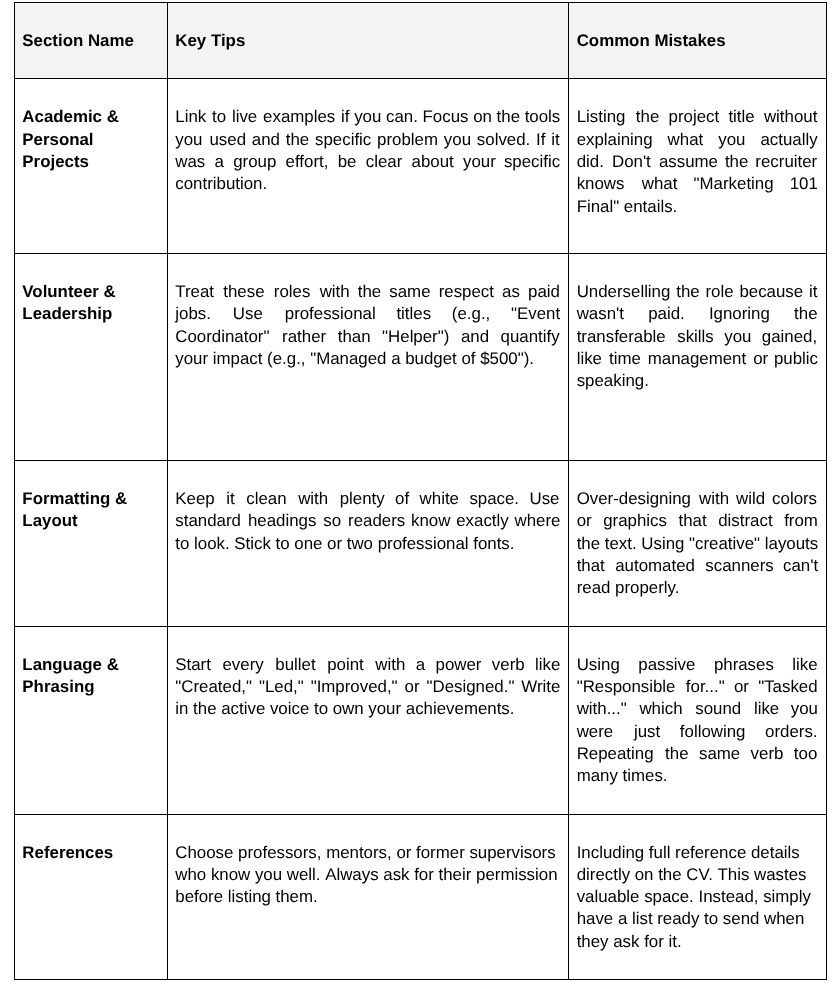
Turning Your Educational Experience Into Skills And Accomplishments
It was shown that teenage career-related activities and attitudes are linked with better adult employment outcomes. So, your experience section is where you prove you can apply what you've learned during your different educational activities and how it affected the kind of employee you wish to become. Remember, experience is more than just paid employment. It’s gaining insights on learning on a much deeper level.
What Counts as Experience?
-
Internships
-
Part-time jobs
-
Volunteer positions
-
Freelance gigs
-
Significant university projects or research
-
Leadership roles in clubs or societies
How to Describe Your Experience
Use bullet points to detail your contributions. Start each point with a strong action verb and focus on your accomplishments, not just your duties.
-
Instead of: "Responsible for managing social media posts."
-
Try this: "Grew the student organization's Instagram following by 30% in one semester by creating engaging video content."
-
Instead of: "Helped with event planning."
-
Try this: "Co-organized a charity fundraiser for 150 attendees, contributing to a 25% increase in donations from the previous year."
How To Highlight Personal And Learning Skills In Your CV?
Employers love to see that you're always learning. A dedicated section for skills and professional development shows you’re proactive about your career.
5 Ways to Show You're More Than Your Degree
-
List Your Technical Skills: Include any software, programming languages, or tools you know (e.g., Microsoft Office Suite, Adobe Creative Cloud, Python, Canva).
-
Mention Soft Skills: These are personal attributes that help you work well with others. Think communication, teamwork, problem-solving, and time management.
-
Add Certifications: Have you completed any online courses or earned certifications? Add them here.
-
Include Languages: If you speak more than one language, be sure to note your proficiency level.
-
Show Your Curiosity: Demonstrating an interest in broader topics can make you a more well-rounded candidate. For instance, understanding the business and finance world is a plus in almost any field. Educating yourself on investment markets comes first because it lays the foundation for every other decision you make on this journey. It signals that you are commercially aware and a self-starter.

Final Touches: Polishing Your Resume
You're almost there! A few final steps will ensure your resume is polished and professional.
Your Pre-Submission Checklist:
-
Proofread, then proofread again: Typos and grammatical errors can give a bad impression. Read it aloud or ask a friend to review it. A fresh pair of eyes can spot mistakes you've overlooked.
-
Save it as a PDF: This preserves your formatting, so your resume looks the same on any device. Name the file something professional, like "FirstName-LastName-resume.pdf".
-
Tailor your resume for each job: Customize your resume by aligning your skills and experience with the specific requirements of the job you’re applying for. This shows employers that you’ve put thought into how your background matches their needs.
-
Add a strong personal statement: Begin your resume with a concise personal statement that highlights your key strengths and career goals. This gives potential employers a quick snapshot of what you bring to the table and sets the tone for the rest of your resume.
-
Proofread thoroughly: Typos and errors can leave a negative impression. Carefully review your resume or ask a trusted friend to read it over to ensure it’s polished and professional. Attention to detail matters!
Your Education Can Be Your First Experience: Don’t Underestimate Its Power
When you're just starting your career, it’s not unusual to feel like you don’t have enough experience to fill a CV.
But here’s some good news: your education is a powerhouse of practical know-how and accomplishments, even if you haven’t held a full-time job yet. By drawing on your academic projects, group work, presentations, or research, you show employers that your time in the classroom was about more than memorizing facts—it was about taking on challenges and seeing them through. Framing your education as experience helps employers picture you stepping into a professional role and making an impact from day one.
Finally, You Are Ready for the Next Step
Your resume is a living document that you'll update throughout your career. By following these steps, you can create a powerful tool that opens doors to exciting opportunities. You’ve done the work, and you have the talent. Now it’s time to build a resume that lets everyone know it.